Sunday, 12 May 2013

Data Structure


By
Raul Bernardino (Dino), B of Comp. Sc., MSc in ISM

Introduction:
Lists and Queues are enormously used in the operating systems whereas to control various tasks in different stages of the execution. These tasks are stored in the queues and it structured by first in first out (FIFO), (Brookshear, 2009:374). This operation is proper for certain application; however it is not use for controlling blocks in the operating system. The operating system much more efficient by using high priority task first or use simultaneously (lists).
[2] List in Data Structure:
A listing or computing is a data structure values that’s in sequence, where the same value can be occurred in more than one place. In computing or listing of data types can also view as model of mathematics, which has similar behavior for certain class of the data structures.  An instance of a value in the list is usually called an element.  In a listing, we can also make a link to the list of the data structure itself, where it consists of an order of data records.  The records are fields that contain an address to the next record in the sequence. This is allow us, to easily shorting a data, adding new data or insert new data and delete data, or easily moves data from list to other end.
A field of node contains information of next node calls a pointer. A first node is a HEAD of a list and the last node calls TAIL minus that node.


A circular link diagram


[5] A single link diagram


[4] A doubly link diagram

[3] Queue in Data Structure:

Queues in general as it pictured below is FIFO model. FIFO stands for First In First Out.


FIFO queue model
A queue is group whereas members are a collection of objects that keeps in the line. The elements can be only adding from the back and only deleting or removing from the front. Some examples are the queues in front of the cashier for the payment or deposits in the banks. The cashier will be only serving the first-in person in the queues. The queues also have a limited to the available of the rooms, places or buffers in the case of computing.
There are two term for queue which are overflow and underflow. The overflow is adding a new object to the full queue. The underflow is deleting object from an empty queues.

Some questions about memory mapping
#1.  Suppose a homogeneous array with 6 rows and 8 columns is stored in row major order starting at address 20 (base ten).  If each entry in the array requires only one memory cell, what is the address of the entry in the third row and fourth column? What if each entry requires two memory cells?

When data is stored in the rows, the major order of the rows are stored first horizontally in adjacent memory locations. When one row is stored, the next one is stored adjacent to the last entry in the previous row.

1 memory cell per item of the data
In the above scenarios, if the starting location was 20 the first row of data would be stored in locations of 20 to 27 and the second row would be stored in locations 28 to 35 and the third row would be stored between locations 36 to 43. The location of the 3rd row and 4th column would thus be 39

[6] 2 memory cells per item of data
In the above scenario the first row would occupy memory locations 20 to 35, the second row would be stored between locations 36 to 51 and the third row would be stored between locations 52 to 67. So the required entry would be stored in memory location 58 to 59.

#2. Describe a method for storing three-dimensional homogeneous arrays. What addressing formula would be used to locate the entry in the ith plane, jth row, and the kth column?

Ordinarily, the values posed within the question would be stored within the computer memory in one of two ways (Row major order or Column major order). These are then grouped together within the computer’s memory. When this is done, we can refer to the location by specifying the row and column. For this exercise, we will also add the plane data for further location (a little like locating an object floating in a cube).
Therefore, if we suppose use the following formula:
X = Address of the cell containing the entry
For this exercise:
I = 4
J = 10
K = 11 (Represents the number of columns)

X + (K*(I – 1)) + (J – 1)
รจ X + (11*(4 - 1)) + (10 – 1) = 42
Answer = 42
The answer or information can then be translated through the use of software routines into locations within the computer’s memory. In this case 4,2.

Moreover, there are some related questions in the software engineering as follows:
#3.  Explain how the lack of metrics for measuring certain software properties affects the software engineering discipline.
Unlike the traditional engineering disciplines where concrete and quantitative, methods for verification of the product, software engineering isn’t blessed with such methods. These methods are called metrics and lack of them is a cause for various problems with software systems. The most immediate impact of the lack of quantitative metrics is the unreliable nature of the end product. Software that can’t be verified can never be sure to perform consistently under all possible operating conditions.

Unless suitable metrics are found for testing the validity of software to the same degree of effectiveness as other more traditional engineering disciplines it is going to be hard to argue the case for software engineering to be considered as part with traditional engineering disciplines. Brookshear [1] compares the current state of software engineering to the position mechanical engineering was in the early seventeenth century before Newton and others discovered the basic mathematical measurements for mass, acceleration and force and their interrelation.

Research in software engineering would have to focus on the discovery of similar fundamental principles which can be applied generically to all software development endeavors. At present most development projects are engineered from scratch.

Although the lack of quantitative metrics affects all aspects of software engineering but the following are perhaps affected more heavily.
Reliability
Software cannot be guaranteed to be reliable if all new projects are developed from scratch as all the mistakes are repeated again and again. The idea of building entire software systems from prefabricated modules using them as building blocks is the focus of much research and interest in the IT community.
Testing
Non existence of any quantitative measures for testing software results in systems rigged with errors which on occasions have caused catastrophic results and have come very close to total destruction. The big hurdle in the way is the intolerance of errors in software systems where software either functions properly without errors or produces the wrong results with the presence of the smallest of error (a missing expression or a wrong operator). It is the effort of eliminating the construction of primitives every time software is developed that is the goal of so many academic and commercial organizations.
Security
With the advent of distributed systems and the explosion in e-commerce and internet systems security has become a major issue is software systems. As software systems cannot yet be defined and tested for all their operating states it is impossible to plug every security hole in the system and discover every error that may exist.
Project Management
The unpredictable nature of software projects puts incredible strain on those tasked with managing the projects. They are often asked to make assumptions about the likely cost of developing a system before any design work has been done and as there exist no metrics for defining a project’s work breakdown structure and the effort associated with them.
Estimating
Software project estimation remains a work of art than a science due to the lack of metrics in the software engineering discipline.

#4. What is the difference between coupling and cohesion? Which should be minimized and which should be maximized?
Coupling refers to the connections between modules; cohesion refers to the connectivity within a module. On the surface, one would like to minimize coupling (because that leads to independent modules that can be maintained individually) and maximize cohesion (because that leads to modules whose activities can be more easily understood).

References:

[1] Brookshear, J. (2009) Computer Science: An Overview. 10th ed. Boston: Pearson Education, Inc.
[2] List or computing [Internet]. Available from: http://en.wikipedia.org/wiki/List_(computing)  (Accessed: 13 November  2010)

[3] Queue of data structure [Internet]. Available from: http://en.wikipedia.org/wiki/Queue_(data_structure) (Accessed: 13 November 2010)

[4] Double link list [Internet]. Available from: http://en.wikipedia.org/wiki/File:Doubly-linked-list.svg  (Accessed: 13 November 2010)

[5] Single link list [Internet]. Available from: http://en.wikipedia.org/wiki/File:Singly-linked-list.svg (Accessed: 13 November 2010)
[6] Multidimensional Array [Internet]. Available from: http://courses.cs.vt.edu/~csonline/DataStructures/Lessons/2DArrays/index.html (Accessed: 13 November 2010)

Monday, 22 April 2013

The use of Software Enterprise and Development in the Organization


By Raul Bernardino (Dino)

Abstract:
In average, many organizations are fallen into the trap of the software application features, its advertisement, based on incomplete information, and software provider persuasion (marketing staff’s skills). They (Institution, Organizations, Company, and Government entities) do not think twice to have and implement the applications immediately in their business environment. Moreover, Information Technology (IT) planners also contributed to the failure of IT implementation projects in organization. Most of IT planners without have enough soft skills such business analysis, leadership, risk management, change control, etc. that can helps to mitigate future system integration and its ward investment.

The larger or well-known organizations tend purchased and customized software enterprise for their business purposes from outsource. The small software enterprise company is most likely to purchase from big software industries. While others, may use several sources of the software enterprise to fulfill their needs.

It is important that the investment in the software enterprise application should be fitted into organization requirements and needs. The quality output of any software enterprise development is relatively varied. This is because, each of the individuals have a different interpretation on the result of software development. The involvement persons in developing or in buying will be giving a high mark on the software enterprise quality, while others who are not involved, will be marking with a low quality.

Since software enterprise and technology industries developed, many methodologies and approaches have been introduced. They are waterfall, spiral, prototypes methodologies, etc. Each methodology has its own advantages and disadvantages.

Introduction:
Software enterprise development is an increasingly persistent part of our daily lives. In the USA alone, the software products and services exceeded $140 billion in 1998 with more than 2 million software programmers employed. This includes not “only Microsoft or Oracle but within all IT departments in the USA” (MacCormack, 2001).

In the Timor-Leste alone has been introduced various software enterprise. Timor-Leste government has been invested in this sector with significant amount money. Let’s name several of them; Free Balance as finance core business application, Portals, e-procurement, etc. Many of them have different platforms whereas no scalability, no cross platform, no workflow, and open standard capabilities.   

In obtaining any software application for the organizations, the management or CEOs have to decide either to develop in house, to develop from outsources, or to purchase from the software industries.

The decision is based on the organizations’ needs and requirements which have been documented or gathered by business and system analyst.

Buy a Software Enterprise: 
In the largest organizations most likely software enterprise application tends to be both “custom developed and procured from outside sources. Small business software applications are most likely purchased. Others businesses may use various sources of the software applications to fulfill their own needs” (Hall and Fernandez-Ramil, 2007). According to Martin et al (2005) that the investment in the “enterprise system packages with integrated modules became a major trend by the late 1990s”.

There are several advantages of purchasing software enterprise application as follows:
  1. Cost savings
  2. Faster  implementation
  3. A possibility of better support for generic business functions


The disadvantage of the purchasing software enterprise applications is the lack of an exact fit in with organizational needs as “building custom software can result in fewer trade-offs and a better fit to the company’s needs” (Martin et al, 2005). New purchasing software enterprise application may not have a scale-ability, cross platform and open standard capabilities; therefore, organizations will spend an additional cost for the training and users spend additional time to re-entry the same amount of data that have been in the system. 

Develop Software Enterprise:
The changing of the software application in organizations is based on the business operations’ needs - often to be a more competitive institution. For instance, repair the bugs and errors, adapt the application, and add new requirements.
The Software Changing Research Result Graph
Software Changing Research:
Sommerville (2004) described in his research on software changes, “error and repairs application is 17 percent, adapting software application 18 percent, and adding functionality or modifying the functionality of the software applications is 65 percent. The research found that the majority of software application changes are on system application modification and adjusting to the business requirement and needs.

“The size of the software and the complexity can grow very quickly, only limited by the productivity of the people developing the software and the capacity of the computer [on] which [it] will be executed” (Hall and Fernandez-Ramil, 2007:304).

 Software Development Quality:
 “The high quality means fitting to the project purposes and satisfying the expectation of the stakeholders and it is not cause damage to them. The external quality process is needed in order to improve the overall quality enhancement and it also creates secondary complimentary views on the system that embodied in the implementation” (Hall and Fernandez-Ramil, 2007:363).

 
The Software Quality Diagram
The internal factors of software quality are built in the modular, able to maintain, testable, re-useable, adjustable, interoperable, readable, and understandable. The process factors of software quality are able to improve, able to track, able to maintain, predictable, and repeatable.  The external factors are efficient compare to other system applications, the functionality of the system, and reliability of the system, adaptability, robustness, and accuracy.   
  
As organizations adopt new computer aided design technologies, “the development processes for many software products increasingly resemble those found in the software industry” (MacCormack, 2001). Therefore, IT managers and CEOs need to be aware of the methodologies for developing and deploying software products and services.

There are many methodologies and approaches below for the organizations to use. However, more important than any one methodology is how to use people and resources to create and maintain the software applications. The software development methodology details are explained below:

Traditional Models (Code and Fix Model):

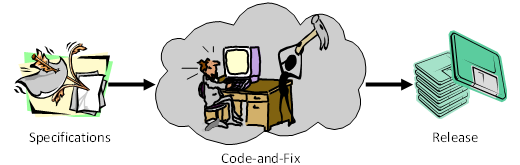
Code and Fix diagram
This model is simple and has been commonly used. The advantages are you can start developing a software application with general or specific ideas. By using this method you do not need to hire an expert in planning, testing, or documentation. Anyone who has knowledge of coding can start writing codes. Unfortunately, since it has no documentation, we cannot assess the progress until it is completed. Additionally, this method does not fit a complex project.

 The waterfall Model:
Waterfall model
This model has highly structured features and sequential processes. We cannot develop tasks randomly; it has to follow the steps of the process. We have to complete all tasks in a stage (for example, stage 1) before moving on to the following stage (in this case stage 2). For instance, in this model, we have to complete all requirement specification and verification before moving on to the software design stage.

This model is adopted from Japan and is named for a Japanese style of presenting sliced, raw fish. This model has overcome some of the weaknesses of the waterfall model. For example, you may start software design before considering the requirements, which brings some flexibility to the development of the software application. However, this model may cause confusion in the other phases, is not particularly efficient, and can leave developers guessing at the overall progress, or even the progress of the individual stages.

The Waterfall with Sub-projects Model:
Sub-project Model
This waterfall with sub-project model is even better in architecting the logical dependence in the subsystem development. This model allows parallel planning in the waterfall model. However the weakness of this model is the possibility of unforeseen inter-dependency among sub-projects.  


 The Spiral Model:

Spiral Model

This is an incremental model of developing a software application. The first process starts from center position and moves clockwise across the area. The first circle, or transversal, is for requirement planning. Each circle has planning, evaluation, risk analysis, and engineering or prototypes. “The first round is the stage of feasibility study. The second round is [for the] concept of the operations. The third round is the top level requirements specification”, (Boehm, 1998:65-69).  Each loop represents a phase of the process. For instance, the inner loop may be feasibility, the next loop requirement, the following loop design, etc. Bear in mind that development in each cycle has to exercise the risk analysis. As soon as the design stage begins, we have to create the testing plan and user documentation. 

Staged Delivery Model
The staged delivery model defines specification with delivery stage. The entire product design specifies that development should take place in the early stages. The advantage of this model is that the user or customer gets functionality earlier than in other models. You have to be careful, however, in the planning and design phases. For instance, component B is schedule for stage 3 but needs to be included in stage 2. 

The Prototyping Model:


Prototype Model
This model’s principle is to help customers and developers understand the system requirements. It includes back to back testing, detection and identification of missing or confusing services, and development of a prototype as a basis for delivering a system specification and working system early available in the process.

The Hybrid Model:
 In the development of the large or complex system we may use several models simultaneously. A prototype may be used for high risk assessment. The waterfall can be used for developing systems that are well understood, and life cycle can be used to determine the organization of the software.

The Agile Model:
The agile model provides several approaches such as an Adaptive Software
 Development (ASD), Crystal methods, Dynamic System Development Methods
 (DSDM), eXtreme Programming (XP), Feature Driven Development (FDD), Lean
 Development (LD), and Scrum models. Here, we will focus on ASD and DSDM.  The
 ASD life cycle focuses on developing working software one small piece at a time. The
 customer describes the functionality and features of the system and developers 
develop it at each stage. The diagram below shows the ASD life cycle.

The ASD Life Cycle Phases Model


The DSDM provides an overall framework of the software project developments. The principles of DSDM are users’ involvement and business rules, team decisions; focus on frequent product delivery, iterative and incremental development that fits the business purposes, reversible changes, and baseline requirements for software development, integrated testing throughout the system, and collaboration and cooperation between all stakeholders. The diagram below shows the DSDM method.
  

The DSDM method adopted from (Highsmith, 2002a) Model       


The Developer:
The developers during developing software are using several software processes model. The fundamental concept of the software engineering is the SDLC, which is stand for Software Development Life Cycle. The life cycle of software development is developing, using, and maintaining. The common pattern of the industries is products. The only differences are industries production for maintenance is repair process while in the software production, the maintenance is upgrading or updating or correcting.

There are lot of methodology and approach as mentioned above for developing enterprise software. However, there are two common software engineering methodologies that developer and software industries use to use. They are Waterfall and Spiral model.

The Waterfall methodology is providing a linier and sequential or step by step move forward development. As the matter of fact developer is developing software with phase by phase, likewise water is running from high level to low level and it will never go back.

For instance, developing software by using waterfall methodology as follows:
Requirement engineering: The system developer will elicit all requirements in the steps which are to be developed. As other model of processes, those requirements need to put into the functions and challenges that system need to fulfill. It includes analyzing the end user needs.

System design: System designer is involving in the architecture of design and the system has to be proper. In this section, it has to be a system definition, selection of hardware platform, operating system etc.

Software design: The software design is based on the system architecture in which can be defined software blocks and break it down into the code modules. The describe interface and interactive modules including functionality for instant system state, start up, shutdown, output, and error conditions.

Coding: The code is based on software design document. The developers are starting code the unit in small part of the system functions. They (units) are stand alone and later to integrate in software package form.

Software Integration and verification: In this section, each unit that has been developed, it needs a testing of the functionality. Verify each unit is meeting the requirements.

System Verification: In this section, verification for whole system is needed; it includes verifying the original hardware and environment.

Operation and Maintenance: In this part the developer handover to the user to test if all requirements are met the need or otherwise to need change to meet customer needs.  In this stage of waterfall methodology is never ending.

Weakness of waterfall method:
  • It is very important to put to gather all possible requirements at the first stage.
  •  Iteration only happen in the same stage
  • There would be very big maintenance at last stage


While in the Spiral method the process is staring for the center position and move across area clockwise.  The first traversals maybe place for requirement and planning.
  • Planning : to define recourse, milestone, and schedule
  • Evaluation: in this section developer is evaluating and analyzing all requirements and determine goal and task. It includes defines all possible alternatives.
  • Risk analysis: In this section, the developer is to asses both management and technical risk
  • Engineering: In this section, developer design and implement one or more prototypes or sample of application.


The software purchase or development decisions are based on several criteria such as available information from elicitation, being able to predict future features, available technology, and the scientific development. Purchasing or developing software applications is also based on having sufficient knowledge in the field.

In the situation where the decision is made to buy a system application, the outcome may be that it will not fully fit with the business’ requirements and needs. While, on the other hand, a decision made for developing a software application may take more time to develop.

There are situations where a group decision is necessary. For instance, if the decision involves, the imposition of regulations, technology specification, or lack of available knowledge, the organization will need to come to an agreement. The diagram below shows the differences between software development and purchase.
Build or buy decision making Diagram

Monday, 18 March 2013

Digital Image Processing


By Raul Bernardino (Dino)
Abstract: Digital image processing methods stems from two principal areas of the applications. The first area namely the improvement of the image for human information and interpretation and secondly, image processing data for storage, transmission, representation for autonomous machine perception.  We will also bring you some historical background of the image processing, scope, and component of image processing.
Introduction: Picture is the most common and convenient means of conveying or transmitting the information. An image or a picture is worth a thousand words. Pictures are concisely conveying information about positions, sizes, background, and inter-relationships between objects. They are representing two- and three-dimensional information that we can recognize as objects. Human beings are good at deriving information from such images, because of our innate visual and mental abilities. It is about 75% of the information received by human is in illustrative or graphical forms.
Background: The historical background is stated that from Institute of Electrical and Electronics Engineers (IEEE) – the technology advancement organization is a first primer professional society for signal processing scientists and professionals since 1948. Since then, there are several studies being done for the optical technology.
For instance, a group is located in Universidad de la Frontera and their main goal is to develop new optical methodologies and technologies that applied to the image processing in infrared and visible spectrum from live and inert material. The processed information is oriented to propose technological transfer and linkage by alternative solutions for non-destructive and non-invasive diagnostic that allows fast and safe control process in industry and agriculture. Between these photonics methodologies, this group is developing: Optical and digital pattern recognition in visible and infrared region; Infrared thermography image processing applications in fruits; diffractive and polarized images optics; Image processing by optical dynamic bio-speckle applications in seeds. Additionally, they develop optical sensors to agriculture industry is an up-and-coming area from collaborative results of this line. Currently, this line is formed by four researches of Physics Department and Electrical Engineering Department, in three laboratories. Also, this line is interested in to increase the fundamental research, with the training of human resources.
Scope of Image processing: The Scope: The IEEE Transactions on Image Processing covers signal-processing aspects of image processing, imaging systems, and image scanning, display, and printing. It is including a theory, algorithms, and architectures for image coding, filtering, enhancement, restoration, segmentation, and motion estimation; the image formation in tomography, radar, sonar, geophysics, astronomy, microscopy, and crystallography; image scanning, digital half-toning and display, and color reproduction.
This is important for computing professionals to understand how it is processed in order to be able to repair the existing pixel of the images. For instance, in the war scenarios the front line sends digital images to the command center in order to develop a strategy for next movement of combat operation. It will be a cost of life and other resources. Therefore, the images have to be high resolutions and during transmission of the packages or sending data to the destination, data has to be sealed or protected, or even encrypted and in secure mode.

Another example for health care issues such as doctor was not in the place and patient needs urgent prescription from a doctor. He / she (the doctor) can access patient image data from far end. This data image has to be precise and have high quality for diagnosing. Moreover, doctor can use a video conferencing tools to discuss with the team of doctors in ground by using same source of image and determine the diagnoses and so on.

Most investigators and students actively involved in the image processing and analysis field or those who would like to participate in this field will be pleased to have this handbook as a reference. ...I am sure that this handbook will find its place in most academic radiology department libraries and on the shelf of investigators in the field." -ULTRASOUND IN MEDICINE & BIOLOGY (May 2001)


Reproducible research: The Transactions encourages authors to make their publications reproducible by making all information needed to reproduce the presented results available on-line. This typically requires publishing the code and data used to produce the publication`s figures and tables on a website. It gives other researchers easier access to the work, and facilitates fair comparisons. More information on a practical setup.

Multimedia content: It is now possible to submit for review and publish in Xplore supporting multimedia material such as speech samples, images, movies, matlab code etc. More information under Multimedia Materials at the IEEE Author Digital Tool Box
Digital Image Acquisition: 

The following picture shows how the number of pixels determines the resolution of the image:
Image with 35 pixels


Image with 2400 pixels


Conclusion: Image processing is an art work. A professional in this field has to be passion in order to give a maximum result. Pictorials are more informative or rich of the information and it is easy to convey the information to human being. The technology helps human being to capture, process, and record the image information.  It is also helps to reconstruct or to rebuild the current low quality images or captures becomes a better quality objects. Images are also helps to make a precise decision toward the objects.

References list:
Author Digital Tool Box, [Internet]. Available from: http://www.ieee.org/publications_standards/publications/authors/authors_journals.html (Accessed: 7 March 2013)
Vandewalle,P. Kovacevic, J., Vetterli, M. (2009), Reproducible Research in Signal Processing - What, why, and how, [Internet].  Available from:

Universidad de la Frontera(2013),  Digital Imaging Processing, [Internet].  Available from: http://www.cefop.cl/research-and-develope/lineas-de-investigacion/procesamiento-de-imagenes/
(Accessed: 7 March 2013)
Ted’sPhotographics (2013) The Science of Photography – Digital Image Processing, [Internet].  Available from:   http://www.ted.photographer.org.uk/photoscience_digital.htm  (Accessed: 7 March 2013)
Wikipedia (2013) Algorithm, [Internet].  Available from: lhttp://en.wikipedia.org/wiki/Algorithm (Accessed: 7 March 2013)


Tuesday, 26 February 2013

Interpreter vs Compiler

By Raul Bernardino

Introduction:
[1] In the computing field, the commands or instructions which are given by the users are normally use a high level language, whereas the computer machines will only  understand the instructions in the binary formats.  The computer language is known as machine language. The sole purpose of the compiler and interpreter is to convert the user high level language into a machine level language so that it makes the computer understand and executed users’ instructions.

 [2] The translation from high level to a low level machine language calls translator. The translator will be translating all identifier of high level collection into the machine language. The translator act similar to secondary generation of assembler, however, it does not do a compiling.

The assembler uses to compile the machine instructions into short sequence of activities in one single file. The assembler is compiling the instructions, calls compilers.
The other translator calls interpreter. This interpreter is doing an execution of the instructions of the program from high level generation without translating into the machine language.

There would be more delay on interpreting instructions from high level and executing compare to transiting or compiling into low level of programming and execute.

[3] Below diagram shows the compilation and interpretation:


By implementing these two distinctions of the interpreting and compiling, it has its own merits and weakness. If we are using an interpreting mode e.g. the web animation, it will be taking further delay of displaying in other end of the machine. It is because the source codes are in different location. Meanwhile, compiling web animation the source code will be going with the web site, however developer have to think of how it can be display in the far end machine while he or she have no idea what type machine is in the far end. Maybe she or he the developer has some assumption of the type machines. But it is unrealistic. Therefore, more developer are using interpreting mode today.

[4] Why is that most of developer are using interpreter mode in design compare to compiler? There are several reasons as follow:

The Interpreter:
  1. Easier to build an interactive development of the environments
  2. Easy to execute the instructions codes which are they are executed statement by statement
  3. Become a port to different the OSs and processor.
  4. The bytecode is portable to any system with an interpreter port.
  5. Bytecodes are tightly packed   
  6. The only weakness is boring performance
 The compiler:
  1. Compiling whole program in to the machine language
  2. Run in the specific operating system an processor
  3. Machine codes are not dense
  4. Run more faster

References:

[1] What are the differences between Compiler and Interpreter? [Internet]. Available from: http://readanddigest.com/what-are-the-differences-between-compiler-and-interpreter/ (Accessed:  6 November 2010)

[2] J. Glenn Brookshear, (2009) Computer science: An Overview. 10th Edition, Boston: Pearson Addison Wesley, Ch 6, P.282 and P.312

[3] What is the difference between compiler and interpreter? [Internet]. Available from:

http://stackoverflow.com/questions/3618074/what-is-the-difference-between-compiler-and-interpreter (Accessed:  6 November 2010)

[4] The difference between compiler and interpreter [internet].Available from: http://www.antlr.org/wiki/display/ANTLR3/The+difference+between+compilers+and+interpreters (Accessed:  6 November 2010)